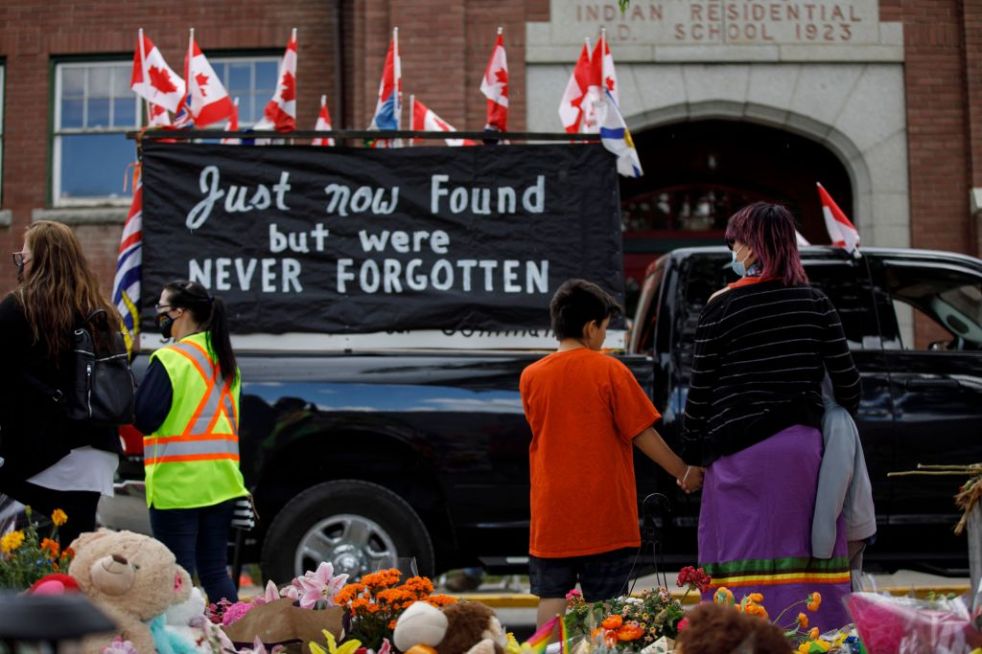
People watch as a convoy of truckers and other vehicles travel in front of the former Kamloops Indian Residential School in support of the Tk’emlups te Secwepemc people after the remains of 215 children were discovered buried near the facility, in Kamloops, Canada, on June 5, 2021. – Canadian Prime Minister Justin Trudeau on June 4 urged the Catholic Church to “take responsibility” and release records on indigenous residential schools under its direction, after the discovery of remains of 215 children in unmarked graves. (Photo by Cole Burston / AFP) (Photo by COLE BURSTON/AFP via Getty Images)
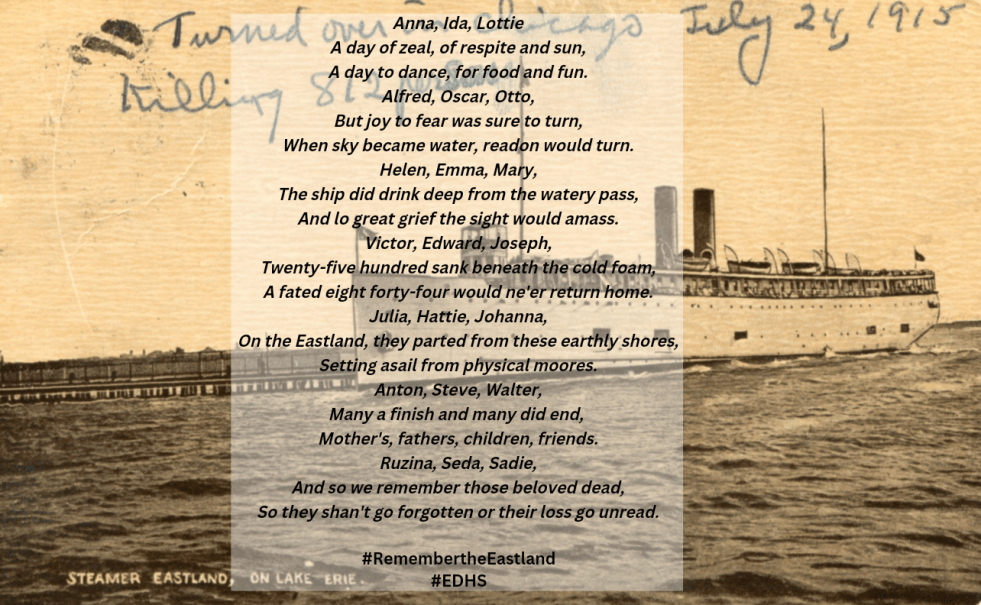
For more information on The Eastland and the tragedy that befell it’s crew and passengers, please visit The Eastland Disaster Historical Society and share it’s story so that the loss that occurred on the Chicago River may never be forgotten.
This poem was inspired by Caitlin Doughty and her coverage of The Eastland at her Youtube channel here, at Ask A Mortician. Please enjoy her other content as well! She is a treasure and a real leader in the death positivity moment, a group aiming to change the way we view, explore, and experience death as a culture and society.
Oh Most High Father, Earth’s grace, Lord of All, your son cries your name in lamentation.
Great is my shame, as sharp as the blade I sheath within the flesh of the Great Worm. Large have been my boastings, my wrongs, and my iniquities. Equally as sizable is the wound that lay within my breast, stinking and festering to the Heavens. Heavy is the weight of my burden as this hour grows late.
Your forgiveness is a balm but the cut of anguish pricks me still. I guard the Sun Barque by night when I wish nothing but to bask in the light of her that is the day.
Golden is she, that goddess of my heart. Monumental has been my grief ever since our story began. But my sister remains and ever will be the heart and soul of our brother, Asar. One half of the whole that they share. Perhaps it was destiny that my sister wife, her twin, should come to despise me so. For how much more monstrous would be my lot if her image continued to be forced to my side? They cannot love me, cannot be mine, because their hearts already belong to their King.
So to the desert, my wasted lands, so seemingly empty and yet still managing to cling still to life. To survive and thrive through adversity, as I shall continue to do into time immemorial. I will bring the sting of the sword and the storm to our enemies and maybe someday that seeping wound will slowly become a scar, ugly for the memory but ultimately a sign of meeting adversity and coming out the victor. Coming out the better for it.
Asar, Lord of the Duat, take him into your shining fields.
Anpu, Protector of the Dead, guide him through the winding dark paths and places.
Setekh, Warrior of the Way, protect him as his spirit finds its way.
Nebet-Het, Mother of Mourners, be with us as we grieve.
Aset, Lady of Life, give his spirit breath again into his next life.
Hewet-Her, Comforter of Comforters, hold him fast as he travels into the lands of the West.
Tehuti, Writer of All Wisdom, give me the knowledge and strength to comfort and give guidance to my family in this time of loss.
Today, after a painful battle with a rare form of cancer, we buried my grandfather. I ended up at home alone after the wake and found myself with a terrible problem. No matter what I did or tried, no matter how much I wanted it, I could not make my brain focus on anything. I wasn’t overcome with sadness, nor were constantly shifting thoughts stealing my attention. There was no depression and all I thought about the wake itself was that I hated to leave my grandmother Ruby to go home alone. I didn’t want her to have to go back to an empty house that would never feel like a home again.
National Novel Writing Month was in full swing but the words wouldn’t come. What was wrong with me? Maybe it was the headache that was working itself out. Maybe it was fatigue. Grief? All I had in me was busy just processing the day, trying to let go of all of the hundred conversations and people. The casket, the coffee. The bowl of mints, the director’s nametag and my mother’s tears.
I found myself writing out, instead of my poor NaNo novel, just an unpunctuated, long single stream of thought with no rhyme or reason. Then, my hopes and prayers for my granddaddy as his spirit passes on. It gave me a sense of…peace. Something like happiness but less than joy. Like he was standing there watching the proceedings and seeing how there wasn’t just tears but there were smiles and humor too. Seeing how the family shored together despite differences and even, in some cases, not even knowing one another. There’s support there and there’s love. I could see him there. He’d probably be wearing navy and looking kind of sheepish with his hands in the pockets of his slacks, his watch on and his chin scruff and he’d be smiling because I think he’d be happy with what he saw.
Afterwards, I still felt like I’d been hit by a truck but on the inside, it felt like finding peace.
My grandaddy, Lehman Franks. I will see you again someday. When we walk the Field of Reeds together, our family will be whole once again.
This image is the original image that accompanied Scott Berinato’s article so, just like the article I share here for you, it is not mine.
So if I haven’t made it clear enough yet, this article isn’t written by me. It was written by the emotional intelligence genius that is Scott Berinato of the Harvard Business Review. I was having a lot of trouble sharing it in the usual way so that’s why I’m sharing it this way.
I’ve been sitting on this article for some time, almost a month since it’s posting on March 23rd, though I don’t know why. I found it so to the point, so moving and right to the heart of things (and to the heart of me). I don’t know why I felt the need to hoard it for so long when it really serves us all to learn how to handle this strange state of perpetual grief that has become our every day.
This grief that we all experience right now, this discomfort that has so far gone unnamed until Mr. Berinato put a name and face to it, seeps into our pores and bones. It leaves nothing untouched and unsullied. It is difficult to imagine mourning for something as intangible as what ‘was’. Yet that’s exactly what this is.
A nameless sadness that sits heavy in the chest. You can’t talk about it because you can’t define it, understand it, or even put a name to it.
So what do you do? How do you move past it?
Scott Berinato has a few things to say about it that I believe we all can benefit from. Words that may help to bring a better understanding to your own experience during these times of quarantine.
<————————————–Article Begins Here And Can Be Found Here————————->
Some of the HBR edit staff met virtually the other day — a screen full of faces in a scene becoming more common everywhere. We talked about the content we’re commissioning in this harrowing time of a pandemic and how we can help people. But we also talked about how we were feeling. One colleague mentioned that what she felt was grief. Heads nodded in all the panes.
If we can name it, perhaps we can manage it. We turned to David Kessler for ideas on how to do that. Kessler is the world’s foremost expert on grief. He co-wrote with Elisabeth Kübler-Ross On Grief and Grieving: Finding the Meaning of Grief through the Five Stages of Loss. His new book adds another stage to the process, Finding Meaning: The Sixth Stage of Grief. Kessler also has worked for a decade in a three-hospital system in Los Angeles. He served on their biohazards team. His volunteer work includes being an LAPD Specialist Reserve for traumatic events as well as having served on the Red Cross’s disaster services team. He is the founder of www.grief.com, which has over 5 million visits yearly from 167 countries.
Kessler shared his thoughts on why it’s important to acknowledge the grief you may be feeling, how to manage it, and how he believes we will find meaning in it. The conversation is lightly edited for clarity.
HBR: People are feeling any number of things right now. Is it right to call some of what they’re feeling grief?
Kessler: Yes, and we’re feeling a number of different griefs. We feel the world has changed, and it has. We know this is temporary, but it doesn’t feel that way, and we realize things will be different. Just as going to the airport is forever different from how it was before 9/11, things will change and this is the point at which they changed. The loss of normalcy; the fear of economic toll; the loss of connection. This is hitting us and we’re grieving. Collectively. We are not used to this kind of collective grief in the air.
You said we’re feeling more than one kind of grief?
Yes, we’re also feeling anticipatory grief. Anticipatory grief is that feeling we get about what the future holds when we’re uncertain. Usually it centers on death. We feel it when someone gets a dire diagnosis or when we have the normal thought that we’ll lose a parent someday. Anticipatory grief is also more broadly imagined futures. There is a storm coming. There’s something bad out there. With a virus, this kind of grief is so confusing for people. Our primitive mind knows something bad is happening, but you can’t see it. This breaks our sense of safety. We’re feeling that loss of safety. I don’t think we’ve collectively lost our sense of general safety like this. Individually or as smaller groups, people have felt this. But all together, this is new. We are grieving on a micro and a macro level.
What can individuals do to manage all this grief?
Understanding the stages of grief is a start. But whenever I talk about the stages of grief, I have to remind people that the stages aren’t linear and may not happen in this order. It’s not a map but it provides some scaffolding for this unknown world. There’s denial, which we say a lot of early on: This virus won’t affect us. There’s anger: You’re making me stay home and taking away my activities. There’s bargaining: Okay, if I social distance for two weeks everything will be better, right? There’s sadness: I don’t know when this will end. And finally there’s acceptance. This is happening; I have to figure out how to proceed.
Acceptance, as you might imagine, is where the power lies. We find control in acceptance. I can wash my hands. I can keep a safe distance. I can learn how to work virtually.
When we’re feeling grief there’s that physical pain. And the racing mind. Are there techniques to deal with that to make it less intense?
Let’s go back to anticipatory grief. Unhealthy anticipatory grief is really anxiety, and that’s the feeling you’re talking about. Our mind begins to show us images. My parents getting sick. We see the worst scenarios. That’s our minds being protective. Our goal is not to ignore those images or to try to make them go away — your mind won’t let you do that and it can be painful to try and force it. The goal is to find balance in the things you’re thinking. If you feel the worst image taking shape, make yourself think of the best image. We all get a little sick and the world continues. Not everyone I love dies. Maybe no one does because we’re all taking the right steps. Neither scenario should be ignored but neither should dominate either.
Anticipatory grief is the mind going to the future and imagining the worst. To calm yourself, you want to come into the present. This will be familiar advice to anyone who has meditated or practiced mindfulness but people are always surprised at how prosaic this can be. You can name five things in the room. There’s a computer, a chair, a picture of the dog, an old rug, and a coffee mug. It’s that simple. Breathe. Realize that in the present moment, nothing you’ve anticipated has happened. In this moment, you’re okay. You have food. You are not sick. Use your senses and think about what they feel. The desk is hard. The blanket is soft. I can feel the breath coming into my nose. This really will work to dampen some of that pain.
You can also think about how to let go of what you can’t control. What your neighbor is doing is out of your control. What is in your control is staying six feet away from them and washing your hands. Focus on that.
Finally, it’s a good time to stock up on compassion. Everyone will have different levels of fear and grief and it manifests in different ways. A coworker got very snippy with me the other day and I thought, That’s not like this person; that’s how they’re dealing with this.I’m seeing their fear and anxiety. So be patient. Think about who someone usually is and not who they seem to be in this moment.
One particularly troubling aspect of this pandemic is the open-endedness of it.
This is a temporary state. It helps to say it. I worked for 10 years in the hospital system. I’ve been trained for situations like this. I’ve also studied the 1918 flu pandemic. The precautions we’re taking are the right ones. History tells us that. This is survivable. We will survive. This is a time to overprotect but not overreact.
And, I believe we will find meaning in it. I’ve been honored that Elisabeth Kübler-Ross’s family has given me permission to add a sixth stage to grief: Meaning. I had talked to Elisabeth quite a bit about what came after acceptance. I did not want to stop at acceptance when I experienced some personal grief. I wanted meaning in those darkest hours. And I do believe we find light in those times. Even now people are realizing they can connect through technology. They are not as remote as they thought. They are realizing they can use their phones for long conversations. They’re appreciating walks. I believe we will continue to find meaning now and when this is over.
What do you say to someone who’s read all this and is still feeling overwhelmed with grief?
Keep trying. There is something powerful about naming this as grief. It helps us feel what’s inside of us. So many have told me in the past week, “I’m telling my coworkers I’m having a hard time,” or “I cried last night.” When you name it, you feel it and it moves through you. Emotions need motion. It’s important we acknowledge what we go through. One unfortunate byproduct of the self-help movement is we’re the first generation to have feelings about our feelings. We tell ourselves things like, I feel sad, but I shouldn’t feel that; other people have it worse. We can — we should — stop at the first feeling. I feel sad. Let me go for five minutes to feel sad. Your work is to feel your sadness and fear and anger whether or not someone else is feeling something. Fighting it doesn’t help because your body is producing the feeling. If we allow the feelings to happen, they’ll happen in an orderly way, and it empowers us. Then we’re not victims.
In an orderly way?
Yes. Sometimes we try not to feel what we’re feeling because we have this image of a “gang of feelings.” If I feel sad and let that in, it’ll never go away. The gang of bad feelings will overrun me. The truth is a feeling that moves through us. We feel it and it goes and then we go to the next feeling. There’s no gang out to get us. It’s absurd to think we shouldn’t feel grief right now. Let yourself feel the grief and keep going.
If our free content helps you to contend with these challenges, please consider subscribing to HBR. A subscription purchase is the best way to support the creation of these resources.
Please go and spam this man with clicks. He deserves all of that sweet, sweet ad revenue that he can get. I sincerely encourage you to go and check out the original article here. HBR has several other COVID-related articles that were truly gems and that I really believe you may enjoy. For now, though, I will return to my own quarantine commiseration. As always,
**ADDS LOCATION OF ACCIDENT** This undated family photo provided by Jessie Crabtree shows back row from left: Anna Esh, John Esh, Amos Esh and his wife Mary and Abner Esh. Front row from left: Rachel Esh, Sadie Esh, Betty Esh and Rose Esh. Anna, John, Rachel, Sadie and Rose all died in the fatal vehicle accident on Interstate 65 early Friday morning March 26, 2010, near Munfordville, Ky., involving a tractor-trailer and a van.
There is a concept among those who honor their ancestors that a person can have bloodline ancestors and spiritual ancestors. Spiritual ancestors are people who you hold close to your heart, so close that you honor them as ancestors of your own.
Think adoption but with more grave dirt.
The Esh Family was one of these for me. They are among those that I hold as spiritual ancestors because of the deep and life changing connection that I found with them. I found a sort of delight in the simple acapella music that they created that had been released on both cd and YouTube. Unfortunately, the song that brought me to them was one played in a memorial video by YouTuber thevineyardworker after their tragic deaths on March 26, 2010. We’re almost upon the tenth anniversary of their loss and even now, their community and far beyond (evidence, yours truly) remembers that awful day. With that, I will put all levity aside from here. Their loss is not something I will embellish with humor.
The Esh family lost their lives when a tractor-trailer stuck their van while they traveled through Kentucky. They were on their way to a friend’s wedding in Iowa. Their two sons, Josiah and Johnny, were the only ones to survive the crash.
Still, that song and their story touched me in a way that I will carry with me forever and today I want to share it with you. This is their song Weep No More from their album Home. I hope that when you hear their song, you remember the Eshes and that life is a precious gift not meant to be squandered or wasted. How will you impact someone with your life? Maybe even your death?
Weep No More
We’re nearing the time when the pearly gates, Are closer than ever before.
I’ve seen just enough I can hardly wait to walk on that golden shore. Children of Zion, Weep no more.
Children of Zion, Weep no more.
We’re headed for that golden shore,
Where God’s holding open Heaven’s door, Children of Zion, Weep no more.
God’s calling His people here below to make the gospel known.
There are many partings here below but someday we’ll meet again. Children of Zion, Weep no more.
Children of Zion, Weep no more.
We are heading for that Golden shore where God’s holding open Heaven’s door.
Children of Zion, Weep no more.
I see my Lord unlocking the gates, a trumpet and Gabriel’s hand.
Just one more Valley and we’ll celebrate on that lovely golden stretch.
Children of Zion, Weep no more.
Children of Zion, Weep no more.
We are heading for that Golden shore where God’s holding open Heaven’s door.
Children of Zion, Weep no more.
Children of Zion, Weep no more.
I hope you find their song, perhaps even many of them, a comfort to you one day. They have been a warm comfort to me through many hardships.
In memoriam, here are the names of those who lost their lives in that fatal highway accident. May you take a moment to remember them today. Maybe light a candle, if one is available, just to show that or thoughts are still with them.
Even after all this time.
After all, the dead only really leave when we let them fade into forgotten-ness. With that, I leave you with a list of those who had lost their lives in that devastating accident ten years ago.
• John Esh, 64, Sadie’s husband
• Sadie Esh, 62, John’s wife
• Rose Esh, 40, John and Sadie’s daughter
• Anna Esh, 33, John and Sadie’s daughter
• Rachel Esh, 20, John and Sadie’s daughter
• Leroy Esh, 41, John and Sadie’s son
• Naomi Esh, 33, Leroy’s wife
• Jalen Esh, Leroy and Naomi’s infant son
• Joel Gingerich, 22, Rachel’s fiance
• Ashlie Kramer, 22, family friend
So take a moment while you wait for the coffee to brew or while you’re in the shower, wherever, to remember those who have gone before whether it be the Eshes or someone close to your own heart. Remember them and they will live on with us forever.
In all of the turmoil, fear, and uncertainty, we are all facing some of our darkest days. Information is rampant and widespread, much of it helpful and some of it, unfortunately, not.
However, that’s actually not what I want to talk about today. Today, I don’t want to talk about what we need to do to keep ourselves safe and healthy no matter what the circumstance comes to. I want to talk about what we can do for each other. Obviously, I’m not saying going door-to-door. What I mean is, what we can do for each other here in this online space.
Something I hadn’t heard of yet was a support group for those not just affected by the COVID/Corona virus but for everyone. Everyone who’s dealing with this fear and uncertainty about what tomorrow might bring. I want to establish a place where anyone and everyone is free to go and talk about what their experience is. What they’re afraid of, what they’re dealing with and also a place that we can go to share this time with others and share support with our fellow human beings.
No matter where you’re from, what borders exist between us, or other lines that we may draw between people and places.
So, here on Little Journeys Everywhere, it’s my mission to create a place where all of this can come together. Where all of us can come together. Because right now, the situation is such that we need each other now more than ever before. We need to support, understand, and share with each other more than ever before, possibly in our history.
It’s my prayer that this sort of support group will help many of us, my own family included, get through the heartache, loneliness, depression, and isolation that can come from illness, distance, and quarantine. So we are going to be launching a social media network support system just for you so that we can all come to the other side of this together.
There is another side to this and we will get there.
Have no doubt about that.
Come join us as we launch the Before The Dawn: A Corona Virus Support Group and leave your stories, testimonials, or words of hope, comfort, and support. It will also be a place where we can put resources and stories of hope for those who need them. Before the Dawn is a community that will be open to all, unmonetized, free of politics, fingerpointing, or bullying. It will be a place that, despite quarantines or borders, everyone can come together no matter your level of affectedness.
I implore those of you who have counseling training or experience to reach out and offer your aid whether it is in Before the Dawn or anywhere else!
Before the Dawn will be on Facebook, Tumblr, and Instagram, and will be linked on our Little Journeys pages. Look for those in the next 24 to 48 hours. The Facebook page can already be found here: https://www.facebook.com/groups/539367610029409/ .
Here on the blog main, I will also be posting ways for you and your families (especially our poor kids) to get through times of quarantine as well as other resources to offer all of us hope and just a little bit of security until we can reach that other side.
On this beautiful Saturday, I want to tell you about a movie that I saw on Netflix just two days ago. Why? In short: I have not been able to stop thinking about it. Here’s why.
My Life as a Zucchini (or in it’s original French, Autobiographie d’une Courgette) is a 2002 novel by the lovely author Gilles Paris, a man I had the distinct pleasure of talking to briefly just this morning. Although his book has been translated into twenty different languages, those regrettably do not include English.
The film, however, has.
My Life As A Zucchini was adapted for audiences for the second time in 2016 as a Swiss-French film directed by Claude Barras in a stop-motion style, screening at the Cannes Film Festival and eventually going on to enjoy a tour at the 89th Academy Awards with an entry for the Best Foreign Language Film and Best Animated Feature Film.
I know that sounds good and all but…
Go watch this movie for yourself.
Please.
I’m telling you that it is so heartfelt, and not in all of those warm gooey ways that we usually associate with that word. No, it is grieving, it is warm. There is kindness and there is hatred. Greed and acceptance. There are angry words but it also contains hearts that are open to new loves. New lives.
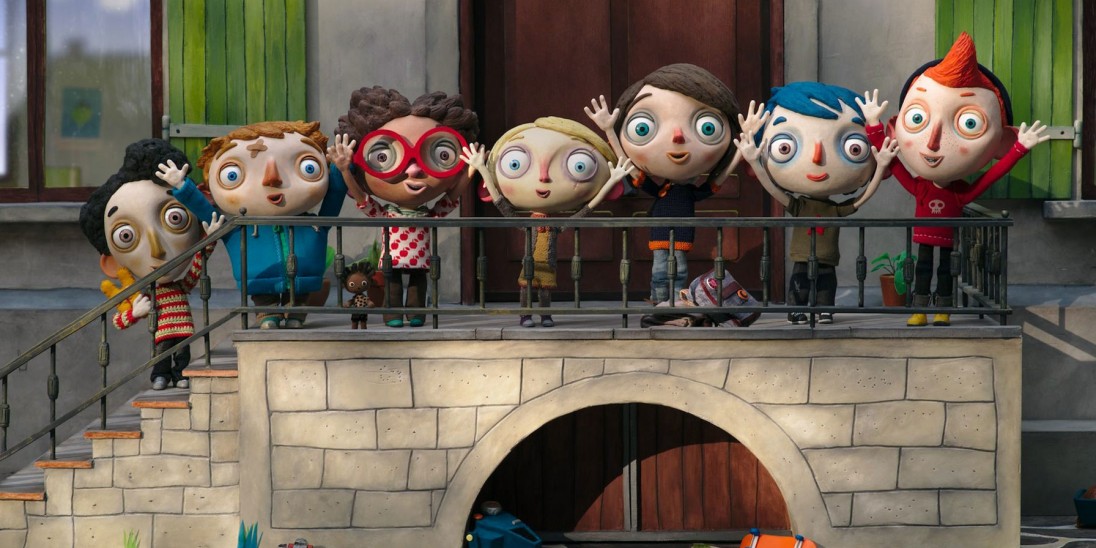
Zucchini’s story is filled with the lost and lonely children that have “no one left to love them” as the boy, Simon, comes to tell him. Simon is a collector of stories, of the stories of all of the children that come through the orphanage, Fontaine’s. Each of them coming from the very worst situations that life has to offer.
Abuse, addiction, mental illness, deportation, a possible sexual abuse case, and eventually we see the child left behind after a jealousy-induced murder suicide.
These kids are the somber reminders that everything we do, our own issues and struggles, don’t just affect us. Our darknesses leave scars behind on more than just our own bodies and hearts.
image courtesy of intofilm.org
Zuchini won’t simply settle for having abuses happen to him anymore though, and neither will his friends. He is capable of making a mark on his situation, even changing it entirely. We see this as he closes the trapdoor on his abusive mother before the title screen even plays out. He dared to say no, to not just take a beating from someone who was supposed to love and care for him.
Granted, he didn’t mean it to knock her down the stairs but in closing that door on her abuse for what we can assume is the first time, he closes the door on that part of his life and the person that he once was. The Zucchini that was forever a victim of others and of his circumstances.
This becomes a sort of theme throughout the short movie where we see the children support and draw strength from one another in times of struggle and to slowly come to find themselves again. They find something else too, something almost as precious.
That there are adults who they can trust, and who want to be trusted.
Adults who can be actually kind, not just putting on a show of it in order to get something out of it.
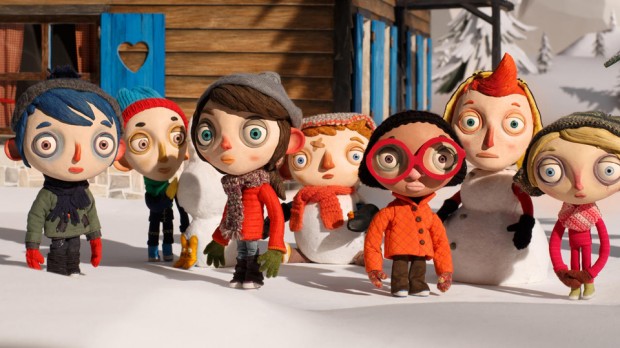
For a movie, there isn’t as much dialogue as you’d expect but so much is said through the brilliantly expressive characters that the creators have brought to life.
image taken from animationmagazine.net
And, oh my Lord and Lady, this scene! The kids are just looking on as a boy has a spill and his mum comes to comfort him. The two realize the unabashed audience they have pretty quickly but Zucchini and his friends don’t care. You become painfully aware while watching it that it’s because they simply aren’t used to seeing a mother comfort a child.
Yeah, no, it’s cool. Totally didn’t need my heart or my soul. Or those tissues wadded in the bin now. You keep those.
So, again, please. Go find this movie on Netflix or elsewhere. Read the book if you know any of the other languages it’s been released in! Give the author, Gilles Paris, some love, enough to send his heart melting.
I know that the tender story that he created certainly melted mine.
Hello to all on this rainy, dreary day (as of my writing this at least!)! I have been fighting long and hard on the battlefields of chronic illness for several years now. Even before I knew what it was, I just explained away the pain and bore it as well as I could. Today on this cold wintry day, we’ve had bursts of sun light up our life periodically as if to personally spite the rain itself. Or perhaps in a delicate dance with it instead? Who can speak as to the nature of nature, after all?
But this bipolar weather reminded me of my own struggles with my body. A body that, at times, literally attacks itself, using my own immune system as a weapon against me.
What a bitch.
The title has been something that stuck with me for more than two years now. ‘What do we do when the tears fall?‘ It was a query spoken from the lips of a girl that went through the same battle I have. Another soldier fighting at the front lines who emboldened herself, taking up the fallen banner of our fight even when she didn’t have to. It was a war she fought victoriously, triumphantly.
Until she didn’t.
She lost her life last year. Her loss echoed and slammed hard through the chronic illness community and all of those whose lives she had touched and changed for the better. Our tribe of soldiers rippled and buckled under the weight of her absence but rather than breaking beneath it…we hardened. We steeled ourselves and fought back against our conditions, our diseases, more furious than ever before.
She used her life to lead others in this fight, to spread awareness in any way she could, to help others new to diagnosis or those seeking one. She gave answers and direction when many of us were lost in the wilds and the night. She was a light to so, so many of us and even now, I think of her often.
So, this piece is dedicated to Jaquie Beckwith who lost her battle in this war on the 29th of April, 2019. Her best friend and fellow soldier has taken up Jaquie’s fallen banner and her husband, Judd, has helped to keep her shop up and running so that those who Jaquie touched are still able to help her family and were able to help cover her end of life expenses. Please see the bottom of the page for links to Jaquie’s channel, pages and to The Raw Life, who helps us all to continue on and carry her beautiful legacy on with us.
Jaquie and her service pup, Harlow.
What Do We Do When The Tears Fall?
What do we do when the tears fall? And fall and fall, I ask of you? When hunger pains and heartache reigns Raining over me and you.
Oh what a dream that it would be! If I were to wake up next to you, And smile and stand without helping hand No aid or pills to get me through.
What if it were all just an illusion? Just a dream within a dream? I’d leave this chair and leave these wheels. My body scrubbed to white, to clean.
I would say goodbye to doctors To ERs, to nerve pain. To side effects and all the rest, To memory loss, it’s wax and wane.
I wouldn’t miss another day, Unless I wanted to. There goes the shame, the disappointment Within me and within you.
But I can’t have that life, that’s true, Though I do my very best. To wear a smile to cover the cracks To steel myself for every test.
My spirit is indomitable, Through dis-ease and disease. I see the sun on a far horizon, Light reaching through the grim levies.
This too may not ever pass, Vile vials at each blood draw. But my disease does not define me! I am my own marshall law.
My voice is but a whisper, Yet it’s cradled gently on the breeze. ‘I’m still here!‘ My voice cries out, To every shining sea.








 Little Journeys Everywhere